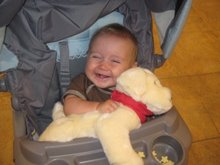
Hello Everyone
Well as most of you know, Nathan's next heart surgery is scheduled for July 28th. He will have a cath done on July 15th which he will stay in the hospital for one night. Then the big surgery will be July 28th. I will use this website like I did last time to update everyone on his progress.
Thank you everyone for being here for us during this time. The move to Boston has gone extremely well! The boys love it here, as do Jason and I. Didnt realize we were going to have his surgery so soon after moving, but everything has fallen into place so far Im sure this will be for the best.
Hope everyone is doing well!
Laura
Monday, June 21, 2010

Wednesday, October 21, 2009
Thursday, October 1, 2009
Interesting....
When Dr. Helen Taussig wrote Congenital Malformations of the Heart in 1947, she described one malformation as “Atresia or marked hypoplasia of the aortic orifice prevents the expulsion of blood from the left ventricle in the normal manner.” Taussig described several variations of the defect – actually different defects, later grouped together under the same deadly name – but could offer no treatment suggestions. Her Tetralogy of Fallot (ToF) patients could at least squat and get some temporary relief; children cursed with this malady died in less than one week. The left side of the heart wasn’t damaged as much as it just wasn’t there.
It wasn’t until 1958 that Dr. Jacqueline Noonan and Dr. Alexander Nadas named the group of defects Hypoplastic Left Heart Syndrome (HLHS). Hypoplastic comes from the root word hypoplasia, which means “small”.
But having a name for it didn’t make it any less deadly as HLHS continued to claim 100% of its victims. This sad story continued until 1985, when the first successful infant heart transplant took place.
At about the same time the Norwood Procedure was developed. Originally designed as one operation (which consistently failed) the procedure was soon split into two heart operations – and eventually three – which seemed to work. HLHS children now had a chance. Obviously long term survival rates aren’t known yet, but approximately 70% survive the three surgery protocol.
And thats when the dirty little secret of HLHS showed itself: While survival rates for the three operation procedure may be in the 70% range, getting from Stage I to Stage II is the hardest step.
The goal of the Stage I operation is to make the Right Ventricle do the job of the defective Left Ventricle – getting the blood to the body. With all of the blood flowing through the right side of the heart, that side is subject to higher flow pressures than it usually receives. A lot higher. In a defect in which the entire left side of the heart is damaged, a successful outcome usually depends on the Tricuspid Valve – located on the right side of the heart.
The inital results were confusing. The Norwood worked – then it didn’t. There didn’t seem to be any rhyme or reason to it, no way to predict outcomes. The surgery itself worked, but too often the results seemed to be as random as a roll of the dice. The answer was the Sano Shunt, invented by Japanese surgeon Shunji Sano – a direct connection from the Right Ventricle to the Pulmonary Artery through a Gortex conduit. (this sounds redundant, but the Pulmonary Artery is normally disconnected from the ventricle in the Stage I operation). Studies showed that survival chances with the Modified Norwood was 11 times greater than with the Classic Norwood.
And now it is time to turn the tables – we’ve got a nasty little trick of our own. Heart defects have to start somewhere… at some point in fetal development, there must be one isolated problem that seems to “snowball” into something bigger as time passes. If we could find that one little problem and repair it then, maybe we can stop the snowball before it gets too big. A pretty cool idea, and maybe one day…
Someday…
A study released Monday (September 28, 2009) revealed that for seven years, doctors at several hospitals in Boston and Harvard Medical School have been detecting Aortic Stenosis in fetuses. Fetal Aortic Stenosis is a snowball; it usually becomes HLHS as the fetus develops.
70 future HLHS patients underwent surgery while still in the womb – a needle was inserted into the mother’s abdomen, passed into the fetus, and into the heart of the unborn child. A small balloon was used to enlarge the abnormally small Aortic Valve. 51 of the procedures were considered successful… and 30% (17 children of the 51) were born with two functional ventricles. That’s 17 children who won’t have HLHS.
Mark September 28 on your calendar… that was the day that the CHD world changed forever.

Friday, July 17, 2009
Nathan Update
We had his cardiologist appt yesterday. Everything went really well!! I am SO SO SO proud of him. He was so amazing. I have never seen a kid be so good while doctors look at them. He smiled and laughed. Even gave Dr. Finnigan a hug and kiss before leaving. I brought all kinds of distractions knowing that the echo would take a while. But he didnt need any of them. All he needed was a bag of 100 calorie oreo cookies:-) During the echo he watched a cartoon and would look over at the tech and smile. He would also stroke her arm and kissed the wand they use:-) too cute! He also liked running around in the halls with just his diaper giving the nurses a good laugh.
He is 23 pounds now! Dr Finnigan said he is doing well. We have a few concerns but nothing that needs immediate attention. He has a leaky valve that we are not sure how bad. So the plan is to go back in December for another echo. Dr Finnigan is debating on weather he should have a diagnostic cath just to get a better picture. He is still guessing his next surgery should be between the age of 3 and 4. So we have another year and a half. Which is good.....but part of me so wants to get it behind us. I know this next surgery is going to be the biggest. But I will take the year and a half of him just being a kid!!!
Thank you so much for all the prayers. We really do appreciate everyone. Nathan is so special and has brought more than I can explain to this this family. He has a purpose and has proven that he is a fighter. I so proud to be his mother:-)
Hope everyone is doing well!
Laura
Sunday, June 7, 2009
Intresting study
***I find this very interesting and a much needed program. There are 2 parents in our support group that lost their sons to an undiagnosed heart defect. Both were in high school. Any parent can ask for a simple EKG and stress test from their family doctor but I believe these test will be offered in schools for all kids once awareness is raised about CHD's.**** Hope everyone is doing well! Laura
On Thursday, June 4th, there was a feature on Channel 11 in Houston on heart screenings at a Houston elementary school. The results were surprising. http://www.khou. com/news/ local/education/ stories/khou0906 04_jj_hearts- free-screening- key-middle- sch.4ab6e5ba. html
By Leigh Frillici / 11 News
HOUSTON -- In May, nearly 100 6th graders were screened for cardiac problems at Key Middle School. Preliminary results show that 10 of those children had problems that needed medical treatment. Two of those students had heart abnormalities that could have led to sudden death.
The findings led those two children to be treated at Children's Memorial Hermann. Five other Key Middle School students had heart conditions that need to be monitored. Three more students had high blood pressure problems that required treatment.
The results surprised Dr. John Higgins, the principal investigator of the Houston Early Age Risk Testing and Screening Study or HEARTS program.
Dr. Higgins said that previous studies indicated that researchers would find one out of 100 students would have heart conditions.
Instead his preliminary results showed one in ten students had problems. Higgins believes this program saved the lives of at least two students especially since Sudden Cardiac Arrest is a silent killer.
Often families do not realize their child has a heart condition until it is too late. Last year, two Houston area students died from heart abnormalities. Both were girls who were in the middle of playing basketball when they died on the court from sudden cardiac arrest.
This study differs from others done in the past. Most heart studies have focused on teen athletes.
The HEARTS program will be testing all 6th graders in five area schools. The children will receive a physical, EKG and ECG for free.
The children that had medical problems will also receive treatment for free, including the children who may need surgery.
The Houston Rockets organization is behind a lot of the funding for this program along with the Memorial Hermann Foundation.
Doctors at Houston’s University of Texas Medical School are also involved with the program.
Dr. Higgins said he would like to expand the HEARTS program to test all 6 th graders in HISD. The problem is funding.
If anyone would like to contribute to the HEARTS fund, you can contact the Memorial Hermann Foundation at (713) 448-5249.
Low cost screening is also available to families that would like to have their children checked for underlying heart conditions. Screenings are available at the Memorial Hermann Heart and Vascular Institute - TMC. The cost is $150. Anyone wishing to schedule an appointment should call (713) 222-CARE.
Friday, May 29, 2009
Great Daddy!

Jason took Joshua on a ride in the rain the other day and they went Rainbow chasing! Here is a picture. They drove around for a long time trying to find the end of it. :-) So long Joshua ended up falling asleep. But he woke up the next day talking about it!
Thursday, May 14, 2009
In the car with Joshua
I was driving Joshua to a playdate the other day and he said....."Mama, please dont push my buttons today"
I told him that I would try hard not to.
:-)
Subscribe to:
Posts (Atom)